Glossary / Cards / Ring
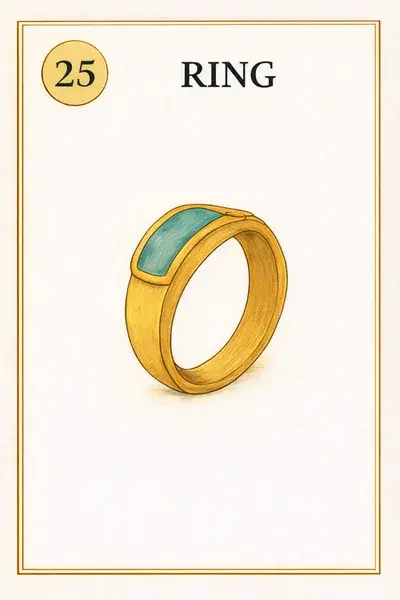
Ring
commitment · contract · cycle
agreements and repeating structures are active
Native house · House 25 — commitment
Caution
staying bound to outdated commitments
Useful action
review terms and renew consciously
Core variants
- 01Ring highlights agreements and repeating structures are active.
- 02At this stage, ring suggests review terms and renew consciously.
- 03Ring carries the keywords commitment, contract, cycle, emphasizing agreements and repeating structures are active.
- 04The gift of ring is that agreements and repeating structures are active, while the caution is staying bound to outdated commitments.
- 05Seen pragmatically, ring points to review terms and renew consciously so momentum can build cleanly.
- 06Ring asks for a grounded response: review terms and renew consciously; avoid staying bound to outdated commitments.
By domain
general
commitment clarity stabilizes momentum
love
partnership agreements need intentional upkeep
work
contracts and recurring obligations shape outcomes
Common pairs
When Ring appears beside these cards:
generalRing + Querent places the bond, promise, or repeating pattern close to home, where your own terms shape what continues.
loveRing + Querent points to the clarity that comes from being honest about the kind of bond you can truly sustain.
workRing + Querent points to agreements or recurring responsibilities that depend on your own boundaries and follow-through.
generalRing + Key defines the terms sharply enough that a bond or agreement can finally be confirmed, revised, or unlocked.
loveRing + Key suggests commitment becomes much clearer once the real terms are named directly.
workRing + Key points to agreement terms becoming clear enough to unlock the next workable phase.
generalMountain + Ring tests a commitment with difficulty — the obstacle puts the bond under pressure and reveals whether the terms can endure.
loveMountain + Ring suggests the commitment is being tested by distance, difficulty, or conditions that make staying harder than expected.
workMountain + Ring marks agreements or contracts under strain from structural obstacles or delays that test durability.
generalRing + Cross ties commitment to serious obligation — the bond carries weight, and the terms must be sustainable or they will become a burden.
loveRing + Cross suggests the commitment carries genuine responsibility, where the promise needs to be honoured with realistic boundaries.
workRing + Cross marks binding obligations with real accountability — contracts, duties, or agreements that carry serious consequence.
generalCrossroads + Ring asks whether the commitment continues as-is, gets renegotiated, or is released — the decision is about the terms themselves.
loveCrossroads + Ring marks a defining choice about the commitment — stay, renegotiate, or release.
workCrossroads + Ring points to a contract decision, renewal, or partnership fork requiring explicit terms.
generalRing + Counterpart names the explicit terms between two people, where mutual obligations can no longer be treated as implied.
loveRing + Counterpart suggests the relationship turns on whether the other person can meet the commitment in a concrete, mutual way.
workRing + Counterpart points to agreements that depend on reciprocal clarity with the other party.
Technique notes
Knighting
- —knights indicate where commitments are tested
- —jump links reveal terms that need revision
Diagonals
- —diagonals show cyclical patterns
- —Ring on diagonals points to long-form commitments